René Mariseau

Tropical cures
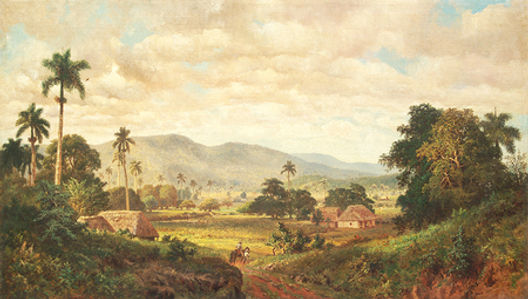
"Cuba con campesinos" – Esteban Chartrand, 1881
During the 19th century, Americans flocked to Cuba. They were drawn by warm sun, gentle breezes, and an unrushed day-to-day pace that helped them relax and unwind. They usually traveled by boat from coastal ports like Charleston and New Orleans and stayed at hotels in Havana, the capital city.
Despite the capital’s attractions, many of these early American travelers left Havana and journeyed into the island’s interior. This was before industrialization. There was no railroad yet, and there were very, very few roads. Cuba was wild and undeveloped, so reaching the interior meant traveling many days on horesback through areas without hotels, restaurants, or travelers’ services of any kind. Considering the inconvenience and the challenges posed by such a journey, why did anyone bother?
The Americans who ventured into Cuba’s boondocks weren’t tourists in the modern sense. In the early 19th century, travel for fun was considered simply too frivolous, and too expensive. Those who traveled usually did so for health reasons, since it was widely believed that climate, atmosphere, and weather directly affected health. A very sick person might travel to a different part of the world and find relief from their symptoms. By the time sick people were willing to pay for travel, they were usually on death’s doorstep. That’s why they the traveling sick were commonly called invalids. It turns out that invalids with respiratory illnesses like asthma and tuberculosis frequently felt better in warm, dry climates like Florida and Cuba (though not for the reasons anyone thought at the time), so sunny destinations tended to be the most effective, and most popular.

"The Invalid" – Louis Lang, 1870
Cuba’s interior region appealed to invalids because its climate was milder than Havana’s, especially in the wintertime, which was when most invalids liked to visit. Havana, the capital and largest city, is located on the north coast of the island. In the winter it tends to be damp and windy. The island’s interior and the south coast, however, are naturally sheltered by mountain ranges and elevated plains, making these regions drier and warmer, and therefore better suited to invalid travelers.
Since there were no hotels in these regions, invalids sought out accommodations on coffee, tobacco, and sugarcane plantations. Most plantations of the interior were massive and had comfortable living spaces. The food was good, the air was warm and dry, and there was plenty of healing sunlight. Cuban planters welcomed American guests. Most had strong economic and social ties to the United States. They sent their children to school in the U.S., and Cuban planter families often intermarried with wealthy American ones.
Building upon these rudimentary social bonds, invalids found it quite easy to literally invite themselves to plantations for weeks or even months at a time. The promise of sun and breeze was not the Cuban backcountry’s only draw, however. It also helped that Cuban planters didn’t ask for payment for any of the goods or services they provided, even to total strangers.
Needless to say, invalids accepted the planters’ extraordinary hospitality, told their friends about it, and wrote about it in travel diaries that they published. Cuban plantation hospitality grew to be very, very popular.
Around Cuban plantations, enterprising locals came forward to provide transportation, entertainment, and other “touristy” services – at a price, of course. Before too long, the economies of key areas of the island revolved around getting Americans to and from the free hospitality that awaited them on these welcoming, yet difficult-to-reach, estates. It was a peculiar arrangement.
It’s surprising that plantation hospitality stuck around as long as it did, however. The mid 1800s saw the rise of pleasure travel all around the world, along with organized tours to places as diverse as Athens, Cape Town, and Colorado Springs. It also saw the rise of industrialization, which brought railroads that made tourist movements to places inland faster and easier. This was no less true in Cuba, and before long, hordes of pleasure tourists took to the physical and logistical pathways that invalids had forged in Cuba, and flocked to the same country estates, often just for day trips. Nevertheless, Cuban planters continued to host American strangers on their estates at no cost.
The planters continued this practice even as their own economic situation deteriorated. In 1827, Spain had agreed to end the transatlantic slave trade. The trade went on covertly, however, for more than 50 years. During this time, the price of its most precious commodity – the healthy male slave – skyrocketed. So did the operating cost of a plantation. Cuban planters were bailed out by Spanish capital, but they paid a staggering 40 percent interest on their loans. The planters of the mid century were at the end of their rope. So why did the planters never try to harness plantation hospitality as a lucrative cottage industry and rescue themselves financially?
One might chalk it up to simple altruism, or better yet, cultural heritage. Hospitality is a major piece of the Spanish mindset. It is the result of centuries of looking after religious pilgrims traveling such routes as the Way of St. James, which runs more than a thousand miles across France and Spain. Starting in the Middle Ages, pilgrims passed through areas of Spain that had few hotels or traveler services. By the 14th century, royal decrees reminded Spaniards to “give shelter to the pilgrim.” These included very specific instructions for not taking advantage of pilgrims; for example, it was forbidden to ask a pilgrim to pay a toll, or to require payment for certain pilgrimage-related needs.
Pilgrims traveling the Way were often in bad health. In fact, bad health was one of the most common reasons people went on pilgrimages. It is easy to see that the American invalids of the nineteenth century were a bit like pilgrims, and it is perhaps not so surprising that they were welcomed as such by the Cuban planters, most of which were of Spanish origin.
But there must be more. After all, the Cuban planters stayed open even after the arrival of the able-bodied pleasure-seeking masses. Social ties to the United States certainly played a role; no doubt hosting wealthy Americans helped Cuban planters consolidate these ties. But their kindness eventually came to serve a less altrusitic purpose.
For much of the century leading up to the Civil War, the United States argued about slavery, which was the very institution that buttressed the Cuban planters’ livelihood. Cuban planters were desperate to restore a legal transatlantic slave trade. For decades, they acquired, as a group, about 10,000 new slaves every year, and they did so literally under the cover of night, lest any outsider should detect that they were in violation of the Treaty of 1827. Most of the slaves, and the harshest slave conditions, and the slave uprisings, were far from the capital city, in the Cuban back-country. But now that tourists were flocking to the Cuban back-country on day trips, the planters needed a new strategy.
Of highest importance was making sure that the manifestations of slavery on their plantations were as idyllic and peaceful as the natural surroundings that drew visitors to begin with. The planters may have done this as a defensive measure, so as not to attract attention to their mysteriously swelling slave populations. But I propose they did so proactively, to take control of the slavery debate... before it took control of them. The planters knew that their hospitality was famous, and that Americans who went home raved to their friends about everything they saw and experienced, including the welfare of the slaves. If the Cuban planters could portray Cuban slavery to the American public as a humane economic system, then their social and economic longevity might be secure again, perhaps indefinitely. It was a long shot, but they had nothing to lose. Their efforts worked, at least for awhile. A huge number of American visitors, including many ardent abolitionists, came away from Cuban plantations starry-eyed about slavery, apparently even reconsidering their views on it.
Julia Ward Howe, a New York abolitionist who wrote the song “Battle Hymn of the Republic,” went to Cuba in 1860 and stayed on a Cuban sugar plantation. Her assessment was that Cuban slaves were “in excellent condition” and, on the whole, cheerful. Such appraisals abound in Cuba travelogues and diaries of the day, many of which were published and enjoyed numerous printings. Perhaps the most astounding appraisal came from Abiel Abbot, a Boston reverend who had attended Harvard with John Adams and was an abolitionist, preaching that “all men are born free and equal.” During a three month stay in Cuba in 1828, as an invalid, Abbot found Cuban slaves to be “fine looking” and “contented,” eating as much “delicious food” as they could hold. Most strikingly, Abbot reported that “the whip is seldom applied; I have never seen it.”
Cuban plantation hospitality was lavish, but over time it became increasingly staged to serve the hosts’ own interests, and it became lucrative for them in a more covert way. To be sure, American invalids and Cuban planters both played an important role in opening the Cuban interior to tourism. American invalids forged logistical and physical pathways for others to follow, and Cuban planters drew American invalids into contact with rural economies, thereby stimulating the creation of peripheral economic infrastructures before industrialization or the rise of pleasure tourism.